
What is a stroke?
A stroke happens when blood flow to part of the brain is interrupted.
Without enough oxygen, brain cells are damaged and die.
As a result, the body may lose certain functions.
For example, an arm may become weak, or you may have difficulty speaking.
The two types of stroke
There are two types of stroke:
• Ischemic stroke: A blood vessel or artery in the brain becomes blocked by a clot, preventing blood from reaching part of the brain.
• Hemorrhagic stroke: A blood vessel breaks and causes bleeding in or around the brain.
 1 in 4 people will have a stroke during their lifetime.
In Québec, 20,000 people every year have a stroke.
A stroke is a medical emergency—every minute counts!
The faster you receive medical care, the less damage there may be.
Approximately 130,000 people in Québec live with physical or psychological effects after a stroke.
Transient ischemic attack (TIA) or mini-stroke without lasting effects
A transient ischemic attack (TIA), also called a mini-stroke, does not cause permanent damage. Blood flow to the brain is reduced for a short period of time. The signs last for a short time, often less than 60 minutes, and disappear within 24 hours.
A TIA is a medical emergency, and you need to call 911.
Signs and symptoms
Different signs and symptoms can occur during a stroke or a transient ischemic attack (TIA).
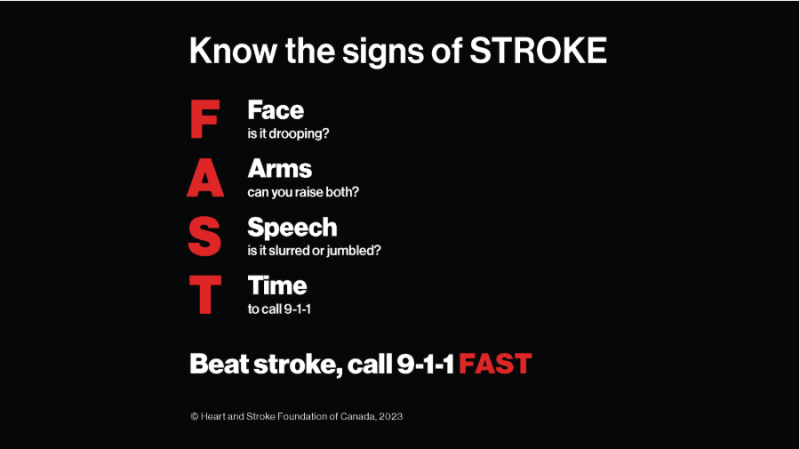
The word FAST is an easy way to recognize the signs of a stroke or TIA.
Other signs to watch for
Some signs are less common and may go unnoticed. These signs can happen suddenly.
Call 911 if you experience any of the following:
- Sudden loss of vision, or double or blurred vision
- Sudden, severe headache
- Dizziness or loss of balance
- Numbness on one side of the body
Watch videos
What to do
- Call 911 immediately.
- Do this even if the signs go away.
What not to do
• Do not lie down to rest.
• Do not wait for the signs to go away.
• Do not wait until you feel pain.
Complications of a stroke
The main complication of a stroke is having another stroke.
The effects of a stroke can range from mild to severe. They depend on:
• The type of stroke
• The area of the brain affected
• The extent of the damage
• How quickly medical care and rehabilitation are provided
Movement
You may have less strength. One side of your body may be paralyzed. You may experience tremors, and your risk of falling may increase.
Speech and memory
You may have difficulty speaking or understanding others. Your memory may also be affected.
Vision and emotions
Your vision may change. You may feel sad or anxious.
Autonomy
You may lose some of your independence. You may feel more tired. Some people experience urinary incontinence.
Stroke prevention
Know your risk of stroke
Talk to your family doctor or another health professional to assess your risk of stroke, or make an appointment through:
• Clic Santé: Screening for type 2 diabetes and assessment of cardiovascular risk*
*Certain criteria apply.
While waiting for an appointment, you can use an online tool to estimate your risk.
Online: RiskScreen
Printable version: Are you at risk for heart disease or stroke?
Reduce your risk
Simple lifestyle changes can help reduce your risk of stroke.
• Eat healthy foods
• Stay active every day
• Get enough sleep
• Manage your stress
• Limit alcohol
• Quit smoking
• Take your medications as prescribed
Medical conditions linked to a higher risk of stroke
Some medical conditions greatly increase the risk of stroke.
Talk to a health professional if you have any of the following conditions.
- High blood pressure (hypertension)
Hypertension means that the pressure inside your arteries is too high. High blood pressure is diagnosed when blood pressure is consistently equal to or higher than 130/80 mmHg. High blood pressure makes the heart work harder. Over time, it can damage the walls of the arteries.
In addition to your doctor, these resources can help you better manage your blood pressure:- High blood pressure | Heart & Stroke Foundation
- Managing your blood pressure
- Mesure de pression à domicile | SQHA
- Reduce salt | Heart & Stroke Foundation
- Hypertension artérielle | Institut de cardiologie de Montréal
You can also request a consultation with a nutritionist. Some centres offer group classes for people with hypertension.
- Diabetes
Diabetes is a chronic disease in which the level of sugar in the blood is too high. The body does not produce enough insulin or does not use it properly. An appropriate diet can help manage diabetes.
You can request a consultation with a nutritionist. Some centres offer group classes for people with diabetes.
To learn more:
- High cholesterol
Cholesterol is a type of fat found in the blood and is necessary for the body to function properly. However, a high cholesterol level can cause the arteries to become blocked, slowing blood circulation. This can affect both the heart and the brain. High cholesterol may be caused by family history, a poor diet, lack of physical activity, or being overweight.
For more information about cholesterol:To learn more:
- Irregular heartbeat (atrial fibrillation)
Atrial fibrillation is a heart rhythm disorder in which the heart beats irregularly and often too quickly. As a result, blood circulates less effectively.
Medications can help. Talk to your family doctor or another health professional.
To learn more:
• Fibrillation auriculaire (FA) | Institut de cardiologie de Montréal
- Sleep apnea
Sleep apnea is a condition that causes pauses in breathing while sleeping. These pauses, called “apneas,” usually last 10 to 30 seconds and can occur several times during the night. During apneas, the throat partially or completely closes. To interrupt the apnea, the body briefly wakes up. Over time, this can cause fatigue and increase the risk of stroke.
To learn more:
• Sleep apnea - Canada.ca
Risk factors related to lifestyle habits
Your lifestyle habits affect your health.
Small changes can help reduce your risk of stroke.
- Poor diet
A poor diet increases the risk of many diseases, including stroke. Eat a variety of healthy foods, take time to eat, and choose simple, fresh foods.
The following resources can help you adopt healthier eating habits:
• Canada’s Food Guide
• Cuisiner pour économiser et favoriser la santé | Fondation Olo
• Manger mieux | TOUGO
- Lack of physical activity
Being active every day improves your health, sleep, and mood. Sitting for long periods or not getting enough physical activity (being sedentary) is harmful to your health. Aim for 30 minutes of physical activity each day. Resources are available to help you:
For adults:
• Improving your health through physical activity
• Bouger plus | TOUGO - Videos and podcasts
• App to improve your lifestyle habits with a personalized plan - LuciFor people aged 50 and over:
• Programme Intégré d’Équilibre Dynamique (PIED) | Santé Montérégie Portal
• Move 50+
• Physical activity tips for older adults (65 years and older) - Canada.ca
• Activités physiques pour les aînés | Direction régionale de santé publique de Montréal
- Overweight or obesity
Excess body weight can affect your health. Obesity is recognized as a chronic disease influenced by several factors, including family history, how the brain functions, eating habits, access to healthy foods, and the environment. Weight management depends on many factors and is not only about diet and physical activity.
To learn more:
• Achieving and maintaining a healthy weight | Heart & Stroke Foundation
- Alcohol
There are always risks associated with drinking alcohol. Even small amounts can have harmful effects.
Programs are available to help you:- Addictions | Santé Montérégie Portal
- Adult rehabilitation program (aged 18 and over) - Addictions | Santé Montérégie Portal
- Directory of addiction resources - Ministère de la Santé et des Services sociaux du Québec
To learn more about alcohol:
- Alcohol | Gouvernement du Québec
- Problems associated with alcohol consumption and drug use | Gouvernement du Québec
- Reducing the health and safety risks associated with drinking alcohol | Gouvernement du Québec
For young adults (aged 18 to 25):
- Smoking or vaping
Smoking increases the risk of stroke. Second-hand smoke also harms others. Vaping is not without risks and is not recommended as a way to quit smoking. Smoking while taking birth control pills greatly increases the risk of stroke.
Different services are available to help you quit:
• Smoking cessation centres | Santé Montérégie Portal
• Tobacco-Free Quebec: quit-smoking portal
• La messagerie pour arrêter de fumer | SMAT
- Drugs
Drug use increases the risk of stroke and can have serious effects.
Ask for help if needed:
• Addictions | Santé Montérégie Portal
• Directory of addiction resources - Ministère de la Santé et des Services sociaux du Québec
• Adult rehabilitation program (aged 18 and over) - Addictions | Santé Montérégie PortalTo learn more about drugs:
• Problems associated with alcohol consumption and drug use | Gouvernement du Québec
• Recognizing drugs and their effects | Gouvernement du Québec
• Drugs: Help and referral
- Stress
Stress affects both the body and the mind. Learn ways to reduce stress. Talk to someone you trust and seek support if needed.
• First-line mental health services - Mental health access desk | Santé Montérégie Portal
• Mental health help and support resources | Gouvernement du Québec
• Reduce stress | Heart & Stroke Foundation
Factors you cannot change
Some factors cannot be changed,
but they can influence your risk of stroke.
- Age
- Sex
- Family history
- Ethnic origin
Factors specific to women
Women have additional risk factors for stroke.
Certain stages of life, such as pregnancy and menopause, can increase the risk of stroke. Talk to a health professional if you have any of these risk factors.
To learn more:
After a stroke
Rehabilitation
Recovery is different for everyone. It depends on your health before the stroke, the type of stroke you had, and your current condition. You may follow one of these three paths:
- Return home with outpatient rehabilitation to help you regain your abilities and resume your daily activities, with or without support at home.
- Admission to an intensive functional rehabilitation unit (IFRU) if you need intensive rehabilitation to return to a safe living environment and your condition is stable.
- Living in housing better suited to your condition (for example, a family-type resource or long-term care centre) if the stroke has caused permanent disabilities and you require long-term care.
For more information:
- Toolbox for individuals involved in stroke rehabilitation
- The stroke toolbox contains information on a wide range of stroke-related topics. The content is based on stroke best practice recommendations and was produced in partnership with the three Santé Québec Montérégie establishments and the Association des traumatisés craniocérébraux de la Montérégie (ATCCM).
- Your stroke journey
- Recovery and support | Heart & Stroke Foundation
Preventing another stroke
Having a stroke increases your risk of having another one. Adopting healthy lifestyle habits can help reduce your risk.
It is also important to monitor your health closely by:
- Making an appointment with your family doctor
- Registering on the waiting list for the Québec Family Doctor Finder if you do not have a family doctor
- Updating your file if you are already on the waiting list for a family doctor
You can find more information (see above) on managing chronic diseases that are risk factors for stroke.
After a stroke: other things to watch for
Some effects may appear after a stroke. Talk to a health professional if you have any concerns.
- Depression
Changes in mood can occur after a stroke, including:
- Impulsivity (difficulty thinking before acting or anticipating consequences)
- Apathy (lack of interest or motivation)
- Anxiety disorders
The risk of depression is higher after a stroke, and depression can occur at any time. Approximately 1 in 3 people experience symptoms of depression. Depression can affect both the person who had the stroke and their informal caregiver. It can also slow recovery.
It is important to recognize both the physical and psychological symptoms of depression.
Learn how to recognize depression by watching the video in the toolbox.
For more information:
To get help, talk to your family doctor or another health professional:
- Sexuality
After a stroke, some people notice changes in their intimate life or their relationship with their partner. These changes can affect people in different ways and vary from one person to another.
Talk to a health professional. Solutions are available to help you.
For more information:
- Driving
Driving requires good physical and mental health, as well as good vision. In addition to the mandatory checks required by the Société de l’assurance automobile du Québec (SAAQ), you must report any change in your health condition that could affect your ability to drive within 30 days of the change.
The healthcare team is also required to report this information to the SAAQ if your ability to drive safely is affected.
- Vision
After a stroke, you may experience vision problems affecting one or both eyes, such as blurred vision, double vision, or partial loss of vision.
These difficulties can make activities such as reading, moving around, or recognizing people more difficult.
Talk to your family doctor or another health professional.
For more information about vision problems:
Useful resources
Informal caregivers
Do not hesitate to ask family and friends for occasional or temporary help if you have a physical, psychological, or psychosocial disability.
People who provide care can also receive support:
The Association des traumatisés cranio-cérébraux de la Montérégie (ATCCM)
The Association des traumatisés cranio-cérébraux de la Montérégie (ATCCM) offers personalized psychosocial and community support services throughout the Montérégie region. Services include psychosocial support, fitness and wellness activities, education and awareness activities, respite services, and housing services.
Appui proches aidants
Appui’s mission is to improve the quality of life of caregivers. This organization helps connect caregivers with services tailored to their needs, including support groups, respite services, and home care services.
Heart and Stroke Foundation